Ask almost any personal finance book how much money to save for home repairs, and you will get the same advice: save 1% of your home's value every year. If your home is worth $400,000, you set aside $4,000 a year, or roughly $333 every month. It sounds clean, simple, and easy to remember.
There is just one small problem: home systems do not care about real estate market appreciation. An asphalt shingle roof costs roughly the same amount to replace whether it sits on top of a $250,000 house in Ohio or a $1,200,000 house in coastal California.
Relying on the 1% rule leaves millions of homeowners either dangerously unprepared for massive emergency repairs or holding onto extra cash that could be working elsewhere. To build a budget that actually works, you need to separate routine maintenance from Capital Expenditures (CapEx).
Maintenance vs. CapEx: The Toy Box Analogy
Think of your house like a giant toy box full of moving parts. Some parts need small, cheap tune-ups every few months to keep working smoothly. Other parts will eventually wear out completely and need to be bought brand new.
Routine Maintenance covers the small, regular tune-ups. This is like putting oil on your bicycle chain or changing the batteries in your TV remote. In a house, maintenance includes changing air filters, cleaning out rain gutters, spraying for bugs, or flushing your water heater once a year.
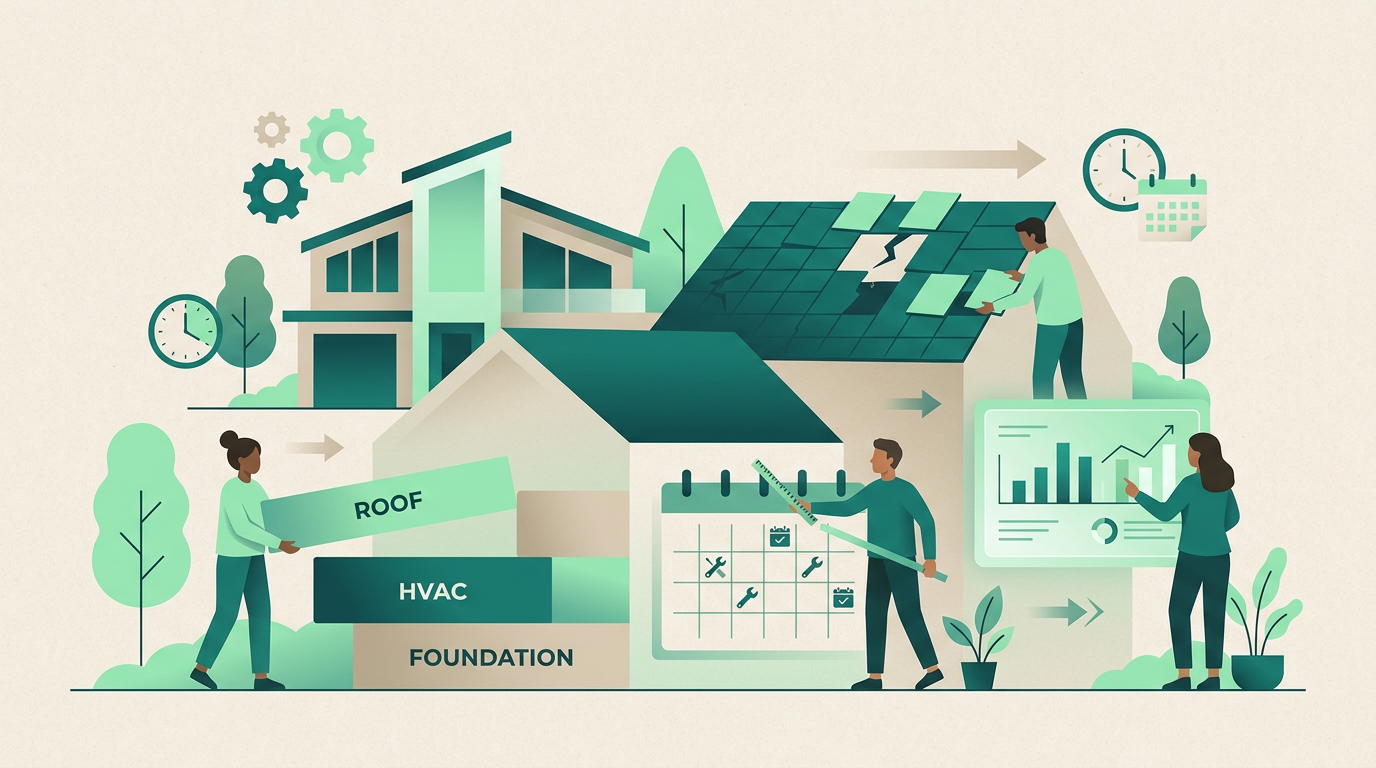
Capital Expenditures (CapEx) are the big, expensive full replacements. This is like having to buy a whole new bicycle because the frame finally snapped after ten years. CapEx includes buying a new roof, replacing your furnace, or installing a brand-new water heater when the old one leaks all over the basement floor.
The Major Systems Lifespan Cheat Sheet
To plan for CapEx, you do not look at your local housing market estimates. Instead, you look at the age of your big-ticket items. Every major component in your home has an expected lifespan, and knowing those numbers is the key to realistic budgeting.
- Asphalt Shingle Roof: Lasts 15 to 25 years. Typical replacement cost: $8,000 to $15,000.
- HVAC System (AC & Furnace): Lasts 15 to 20 years. Typical replacement cost: $7,000 to $12,000.
- Water Heater (Standard Tank): Lasts 8 to 12 years. Typical replacement cost: $1,500 to $3,000.
- Kitchen Appliances: Last 10 to 15 years. Typical replacement cost: $1,000 to $2,500 each.
- Garage Door Opener: Lasts 10 to 15 years. Typical replacement cost: $400 to $800.
Routine maintenance keeps these systems alive until the end of their expected life, but it will not make a 30-year-old furnace run forever. Eventually, every system reaches the end of the line.
How to Calculate Your Actual CapEx Reserve
Instead of guessing a random percentage of your purchase price, you can calculate your exact monthly replacement reserve in three quick steps. Let us look at a real-world example.
Imagine you just bought a house. You check your home inspection report and take inventory of your three biggest aging systems:
- Your roof is 15 years old. It has about 5 years left of life and will cost $10,000 to replace.
- Your HVAC unit is 12 years old. It has about 3 years left of life and will cost $9,000 to replace.
- Your water heater is 8 years old. It has about 2 years left of life and will cost $2,000 to replace.
To find out how much you need to set aside each month for each item, divide the total replacement cost by the remaining months of expected life:
Roof Reserve: $10,000 ÷ 60 remaining months = $166.67 / month
HVAC Reserve: $9,000 ÷ 36 remaining months = $250.00 / month
Water Heater Reserve: $2,000 ÷ 24 remaining months = $83.33 / month
When you add those three numbers together ($166.67 + $250.00 + $83.33), your target monthly CapEx savings goal is exactly $500 per month.
Notice how this math has nothing to do with whether your home cost $200,000 or $800,000. It is based entirely on actual equipment, remaining time, and real repair costs.
Combining CapEx with Routine Maintenance
Once you have your monthly CapEx target, add a small, flat monthly allowance for routine maintenance items like HVAC filters, drain cleaner, and light fixtures. For most single-family homes, setting aside an extra $75 to $125 per month covers day-to-day upkeep comfortably.
In our example above, combining your $500 CapEx target with $100 for routine maintenance gives you a total repair budget of $600 per month. Keep this money in a separate high-yield savings account so it earns interest while waiting for future projects.
What to Do Next
Grab your recent home inspection report or walk through your home with a notepad to list the age of your major systems. Calculate your personal monthly target reserve using the formula above, and update your savings goals. If your calculation shows an urgent wave of major replacements on the horizon, explore your equity options or run the numbers in a refinance calculator to see if tapping your home value makes economic sense for your household.